
A recent BCG report on the biopharma industry projects that tirzepatide-based products will lead the industry in 2030 (Mounjaro and Zepbound total $56B).
Eight of the ten best-selling biopharma products in 2025 are new-modality drugs. (See Exhibit 2.) Three of the top ten are newcomers to the list: GLP-1 agonists Mounjaro, Zepbound (both from Lilly), and Wegovy (Novo Nordisk) … have replaced conventional drug Jardiance (Boehringer Ingelheim and Lilly) as well as two monoclonal antibodies (mAbs), Stelara (Johnson & Johnson) and Opdivo (Bristol Myers Squibb). Analysts project that nine of the top ten products by revenue in 2030 will be new-modality therapies, including five GLP-1 agonists.[1]
[1] https://www.bcg.com/publications/2025/emerging-new-drug-modalities
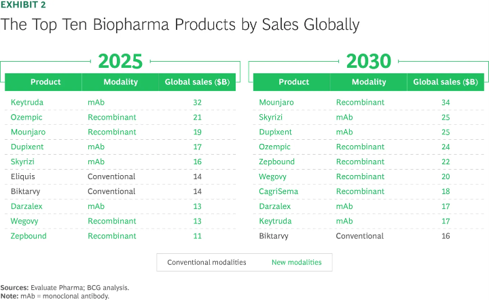
The BCG authors were keen to distinguish “New” modalities from “Conventional” to emphasize an important shift in the nature of blockbuster drugs. We note that tirzepatide drug substance is not produced by recombinant means as indicated in Exhibit 2 but is rather the product of peptide synthesis. While we agree that synthetic peptides should be considered as different than conventional drugs made by chemical synthesis, often the technology of their synthesis has more in common with conventional drugs than a biological product like a mAb. Much of the semaglutide molecule is produced by recombinant means but significant peptide synthesis is required to prepare elements of it. Peptide synthesis at scales not contemplated a decade ago will be an important feature of biopharmaceutical manufacturing for many years.

