
CMC Gap Analysis: From Regulatory Safeguards to Risk Strategy Insights
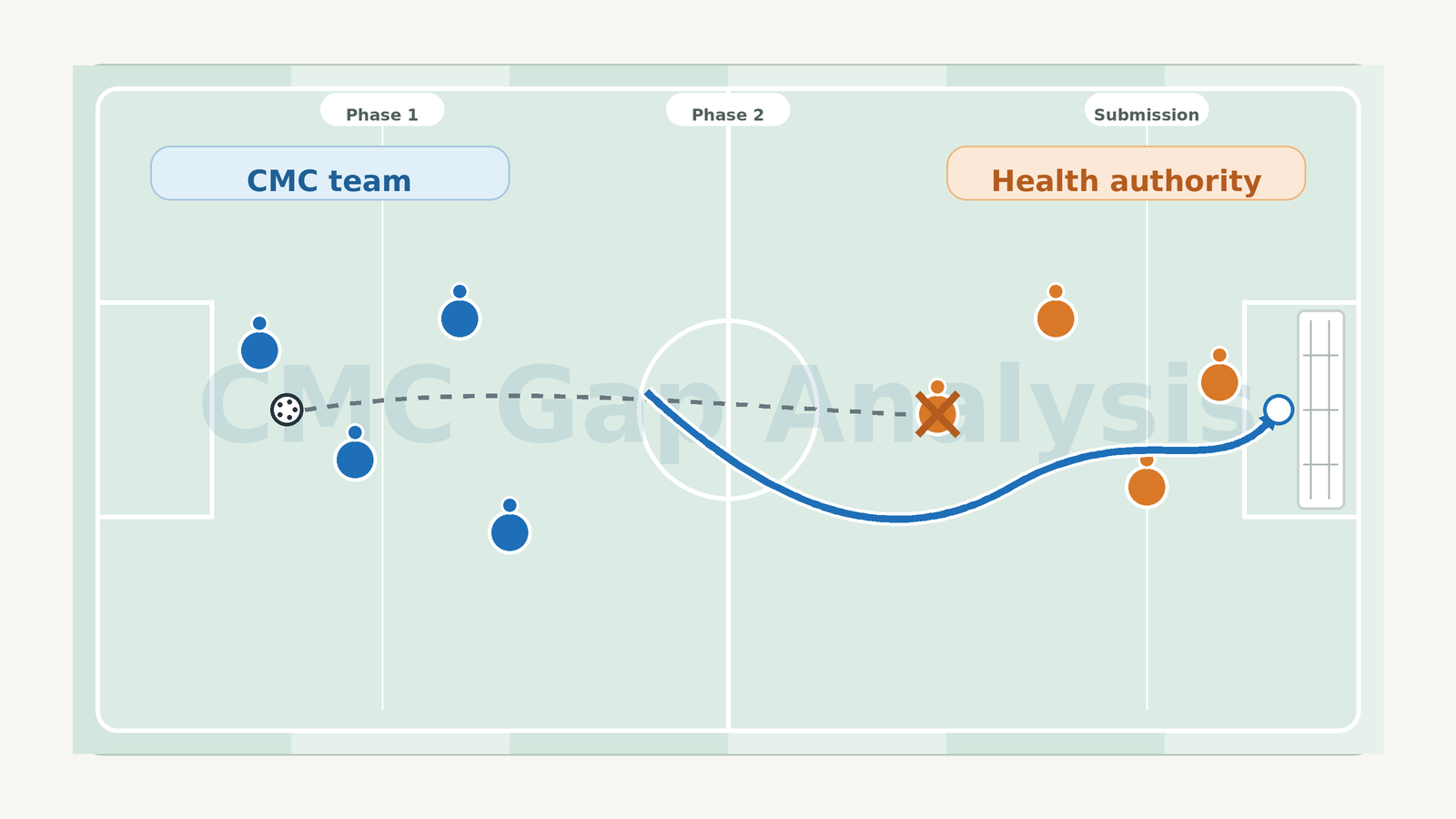
Regulatory expectations for Chemistry, Manufacturing, and Controls (CMC) have evolved significantly over the past decade. Agencies do not assess submissions as static technical dossiers, they evaluate them as reflections of scientific maturity, lifecycle planning, and quality system robustness. In this environment, a CMC gap analysis goes beyond a simple readiness exercise before filing; it is a structured interrogation of whether a product’s technical foundation can withstand regulatory scrutiny and commercial reality. When executed rigorously, it becomes both a regulatory safeguard and a broader risk management tool. This is your chance to ask hard questions and locate weaknesses before somebody else does.
Beyond Document Completeness
A common misconception is that CMC readiness is achieved once reports are written and phase-appropriate validation is complete. Regulatory authorities, however, assess coherence, traceability, and scientific justification. They examine whether development rationale aligns with the control strategy, whether analytical methods reflect a lifecycle approach, and whether process validation demonstrates true understanding rather than historical performance.
A meaningful CMC gap analysis therefore asks deeper questions. Does the control strategy clearly link critical quality attributes to process parameters and material attributes? Is there documented justification for established conditions and specification limits? Is the stability protocol appropriately constructed and defensible? Can the organization clearly explain how process knowledge evolved from development through commercialization? And where does all this knowledge live, who can access it, and how is it protected?
These questions transform the analysis from a checklist review to an evaluation of scientific integrity.
The Lens of Regulatory Feedback
Regulatory feedback trends consistently show vulnerabilities in three interconnected areas: control strategy coherence, analytical lifecycle management, and validation strategy alignment.
First, regulators increasingly scrutinize whether the control strategy reflects ICH Q8 and Q11 principles. Weak risk assessments, insufficient parameter justification, or overreliance on end-product testing can signal limited process understanding. A gap analysis must therefore assess whether the narrative of process knowledge is internally consistent and scientifically supported.
Second, the modernization of analytical expectations under ICH Q2(R2) and Q14 has shifted focus toward lifecycle governance. Agencies now expect defined analytical target profiles, documented development rationale, and structured post-validation maintenance strategies. Methods validated years ago under older paradigms may technically comply yet fail to demonstrate complete lifecycle control. Identifying this discrepancy early prevents avoidable regulatory questions.
Third, process validation is evaluated as a lifecycle continuum rather than a discrete PPQ event. Regulators assess whether Stage 1 (process design) was adequately characterized, whether Stage 2 (qualification) was statistically justified, and whether Stage 3 (continued process verification) is proactive rather than reactive. A CMC gap analysis often reveals that control plans lag development knowledge, a misalignment that can create audit vulnerability.
Building the Narrative of Control
Stability and comparability data are rarely rejected because they are entirely absent. More often, they are challenged because their interpretation lacks statistical rigor or their justification lacks transparency. Shelf-life extrapolation, impurity trend analysis, and commitment protocols must reflect sound modeling and documented decision logic.
Similarly, manufacturing changes including scale-up, site transfer, and process optimization require comparability strategies that demonstrate structural, impurity, and performance equivalence. A gap analysis evaluates whether change management documentation anticipates regulatory classification and whether sufficient analytical depth exists to support post-approval flexibility.
In essence, regulators are not only evaluating data; they are evaluating the credibility of the system that generated the data.
Value Past the Regulatory Milestone
Although often initiated in preparation for an IND, NDA, BLA, or MAA, the utility of a CMC gap analysis extends well beyond submission readiness.
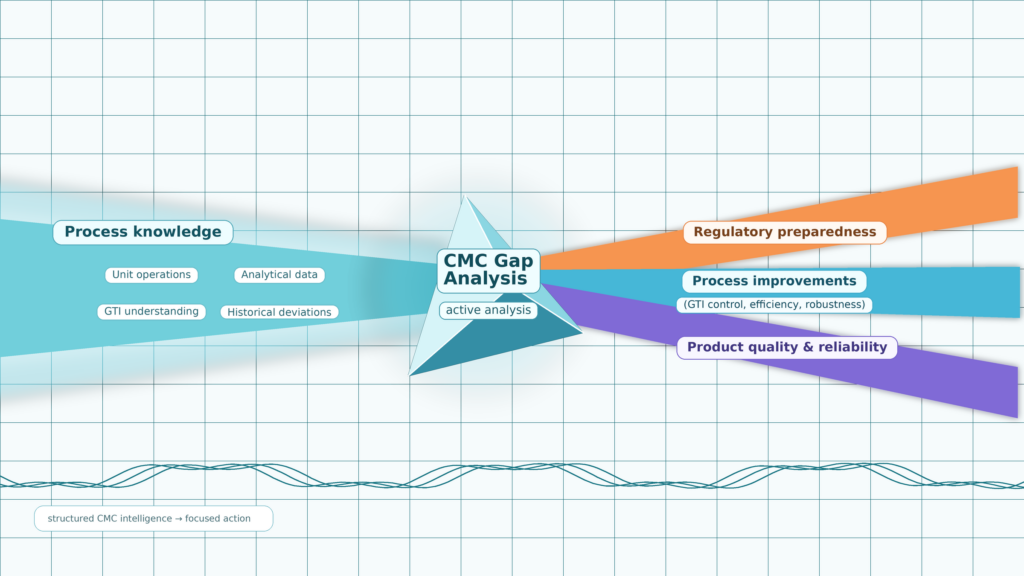
From an operational perspective, it frequently exposes variability drivers that increase batch failure risk. By challenging assumptions embedded in specifications, raw material controls, or in-process monitoring strategies, the organization may identify preventable deviation trends before they escalate into supply disruptions. The result is superior manufacturing resilience.
From a financial standpoint, the timing of deficiency discovery has profound impact. Identifying a weak impurity qualification strategy prior to submission is a manageable corrective action. Discovering it during review can trigger delayed approvals, additional studies, or unplanned validation campaigns. A gap analysis effectively converts uncertain future liability into structured, budgeted remediation.
The same logic applies in transactions. In mergers, acquisitions, or licensing deals, CMC technical maturity directly influences asset valuation. An independent gap assessment can reveal latent remediation obligations, underestimated validation work, or change management inflexibility that materially affects investment decisions. In this context, a CMC gap analysis becomes a due diligence instrument rather than a regulatory formality. It is therefore a powerful negotiation lever that many of our clients have used.
Strengthening Organizational Maturity
An often-overlooked benefit of CMC gap analysis lies in its impact on organizational alignment. Development, regulatory, quality, and manufacturing functions frequently operate with implicit knowledge silos. The act of systematically challenging development history, control logic, and lifecycle planning forces cross-functional clarity.
It also tests data integrity systems and documentation traceability in a manner similar to an inspection simulation. Discrepancies between development reports and executed batch records, inconsistencies in deviation trending, or gaps in audit trail governance may surface during the review. Addressing these issues proactively strengthens inspection readiness and reinforces quality culture. In this way, the exercise contributes to institutional discipline, not just submission preparedness.
A Risk-Based, Stage-Appropriate Approach
Not all gaps carry equal weight, and not all lifecycle stages demand the same level of control maturity. An early-phase asset should not be evaluated by commercial-stage criteria but assessed against phase-appropriate expectations. Effective gap analyses prioritize findings according to potential impact on approval timelines, inspection risk, and supply continuity.
The most valuable outcome is a structured remediation roadmap that integrates technical corrections, resource planning, and regulatory strategy – well beyond an enumeration of deficiencies. When embedded into lifecycle governance rather than executed as a one-time event, the analysis becomes a recurring calibration of technical robustness. This can and should be an integral part of your company’s continued process improvement strategy.
Conclusion
CMC risks rarely stem from complete absence of data. More commonly, they arise from inconsistencies, weak justifications, lifecycle misalignments, or insufficiently articulated scientific rationale. A technically rigorous CMC gap analysis exposes these vulnerabilities before they surface in formal review.
Yet their broader value may be even greater. By strengthening process understanding, reducing operational variability, supporting investment decisions, and reinforcing inspection readiness, the analysis transcends its regulatory origins. It becomes a strategic instrument for managing technical, financial, and organizational risk.
For these reasons, CMC gap analysis is not merely a defensive measure. It is a disciplined expression of scientific and operational maturity that can be genuinely useful for the insights it provides.

