
A Frequently Oversimplified Decision
In pharmaceutical manufacturing, few decisions carry more long-term impact than whether to make or buy an intermediate, regulated starting material (RSM), or API. On paper, the evaluation seems straightforward: compare internal production cost to a supplier quote and choose the lower number. In practice, that approach often misses factors that truly determine economic performance, namely supply risk, capital intensity, process robustness, and hidden cost drivers embedded in the route itself. The make-or-buy decision is not a procurement exercise, but a capital allocation decision under uncertainty.
Start With Strategy, Not Price
Before modeling cost, clarify the material’s strategic role:
- Are there inflexible deadlines (ie. for clinical supplies) that must be met?
- Does it constrain launch timelines or scale-up?
- Is supply continuity critical to commercial performance?
- Does it influence margin in a meaningful way?
If the material defines product quality, yield, or other critical factors, internal control may provide leverage, while if the material is commoditized, external sourcing may preserve flexibility and capital efficiency. Price is important, but strategic positioning is the foundation.
Supply Chain Reality: Resilience Has a Cost
Recent years have exposed vulnerabilities in global supply networks. Single-point sourcing, geographic concentration, and extended lead times create fragility not reflected in nominal price comparisons.
Executives evaluating make-or-buy decisions should consider:
- Probability of supply disruption
- Financial impact of a disruption event
- Recovery timeline
- Working capital implications
- Dual-source feasibility
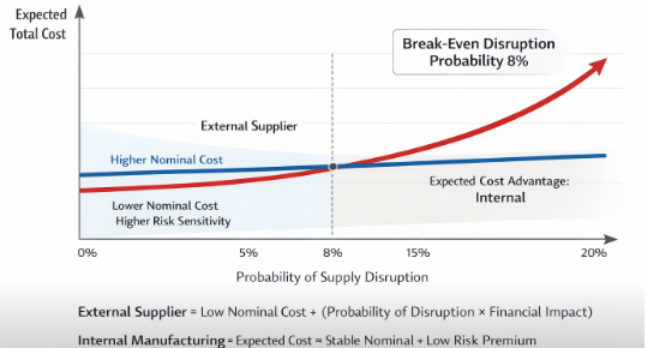
The relevant question is not “Which option is cheaper?” but “Which option has the lower expected cost once risk is factored in?” This can be expressed simply:
Expected Cost = Nominal Cost + (Probability of Disruption × Financial Impact)
In many cases, a lower supplier price crosses above internal manufacturing once disruption probability exceeds a surprisingly modest threshold.
That crossover point is where strategy changes, as illustrated in Figure 1.
Figure 1: Hypothetical Risk-Adjusted Cost Curve for a Make or Buy Decision

Hidden Cost Drivers Most Models Miss
Traditional comparisons often focus on direct variable cost. But the largest economic drivers are frequently embedded deeper in the process. Common blind spots include:
- Excessive solvent usage
- Suboptimal raw material sourcing
- Yield inefficiencies that compound upstream cost
- Over-specified reagent grades
- Waste and reprocessing burden
- Inventory carrying cost
- Opportunity cost of constrained internal capacity
These factors distort both “make” and “buy” economics if not modeled rigorously. The difference between nominal cost and true economic impact can be substantial. The relative vulnerability of the “make” and “buy” strategies to hidden cost drivers is shown below in Figure 2.
Fig. 2 Hidden Cost Drivers by Manufacturing Strategy
| Cost Driver | Make | Buy |
| CapEx | 🔴 High | 🟢 Low |
| Working Capital | 🟢 Lower | 🔴 Higher |
| QA Oversight | 🔴 High | 🟡 Medium |
| Supply Disruption | 🟢 Lower | 🔴 Higher |
| Scale Flexibility | 🟡 Limited | 🟢 Higher |
| Opportunity Cost | 🔴 Often High | 🟢 Lower |
Color Code:
- Green = Advantage
- Yellow = Moderate
- Red = High Risk / Cost Exposure
Sensitivity Matters More Than Averages
Executives rarely make decisions based on average performance; they evaluate volatility, frequently by employing sensitivity analysis:
How much does total cost move when you vary:
- Yield by ±5%?
- Raw material pricing by ±10%?
- Cycle time by ±15%?
- Inventory levels?
- Probability of supply disruption?
In most cases, disruption risk dominates cost volatility. Yield improvements matter, as does raw material inflation. But disruption events, particularly for products in clinical stages and beyond, tend to drive massive financial exposures. When that exposure is quantified, the economic winner often becomes clearer.
When to Make
Internal production is often justified when:
- The material is strategically critical.
- Supply continuity is paramount.
- Internal assets are underutilized.
- Long-term demand is stable and predictable.
Internalization becomes particularly compelling when risk-adjusted modeling demonstrates that volatility erodes the apparent savings of external sourcing.
When to Buy
External sourcing often makes sense when:
- Volume is uncertain or variable.
- Specialized chemistry expertise resides externally.
- CapEx requirements are significant.
- The material is non-differentiating.
- Speed and flexibility are priorities.
In a few cases, the right answer is not to make or buy, but dual sourcing to balance capital efficiency and resilience. In my professional experience, a frequent result of careful should-cost analysis is that the question becomes not “Make or buy?” but “Where can we buy smarter?”
From Static Costing to Strategic Cost Intelligence
The most consistent weakness in make-or-buy decisions is not strategy but visibility. Without step-level cost transparency, source benchmarking, and risk-adjusted scenario modeling, leadership teams often compare incomplete pictures. Advanced COGS modeling platforms, including the work we do at Rondaxe, help surface hidden material cost drivers, sourcing optimization opportunities, process efficiency leverage, and can be used to gauge risk sensitivity across supply and yield variability.
The goal is not to push toward “make” or “buy” but to quantify the economic impact of both. When companies can identify where cost volatility truly sits — and therefore which variables drive the largest ROI — capital allocation becomes sharper and more defensible.
The Strategic Takeaway
Although this sounds counterintuitive, the least expensive option is not always the lowest-cost option. The difference between nominal cost and expected economic impact is where many organizations either preserve or destroy margin. Make-or-buy decisions should integrate:
- Strategic importance
- Supply resilience
- Fully loaded cost
- Risk-adjusted modeling
- Capital discipline
- Scenario stress testing
When treated as a portfolio-level strategic lever rather than a tactical sourcing decision, the analysis of whether to make-or-buy can lead to insights on margin, resilience, and long-term competitiveness.
A Final Thought
The most productive (and least regretted) make-or-buy discussions usually happen when finance, tech ops, and supply chain leadership are aligned around the same economic view of the process. When assumptions are transparent and risk is quantified, the conversation shifts from opinion to strategy.
If this topic resonates, if you’re re-evaluating how your organization approaches these decisions, or if you have a specific process in mind, we’re always interested in exchanging perspectives with others navigating these challenges. The complexity of today’s pharmaceutical supply chains demands better dialogue as much as better data.

