
Pent-Up Supply, Selective Demand, and Optimization-Led Innovation
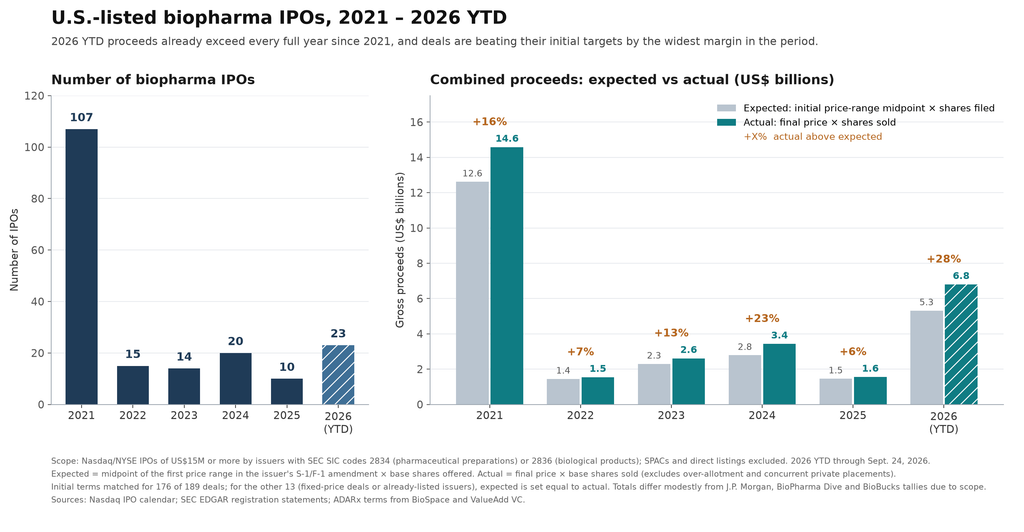
The biopharma IPO window has officially reopened. In the first half of 2026, biopharma companies completed 13 IPOs and raised about $5 billion, which is more than the sector raised in any full year from 2022 through 2025 (J.P. Morgan). This is not a replay of 2020–2021, though. It is a selective recovery from an unusually depressed market, and the reasons behind it matter more than the headline numbers.
Why the Market Turned “Bullish”
Several forces are reinforcing one another:
- A backlog of companies. U.S. biotech IPOs fell from 87 in 2021 to only 11 in 2025 (Fierce Biotech). Private companies kept developing their programs during the downturn and were ready when the window reopened.
- M&A as an exit signal. Large pharma companies facing patent expirations are buying clinical-stage assets. The first quarter of 2026 recorded 19 biotech exits worth $13.3 billion, the highest quarterly value since late 2021 (BioSpace). Proceeds from those exits are being reinvested in new offerings.
- Better public-market performance. The SPDR S&P Biotech ETF reached its highest level since 2021 in December 2025, and follow-on discounts narrowed (Goodwin).
- More mature issuers. In 2025, 88% of life-sciences IPO issuers had programs in Phase 2 or later (Goodwin). Investors want human data, credible regulatory paths, and near-term catalysts.
Pent-Up Supply or Genuine Demand?
The evidence points to both, with pent-up supply as the larger immediate driver. In 2026, 11 of 13 newly public biotechs raised at least $250 million, and nearly all had Phase 2 or later programs (BioPharma Dive). That fits the profile of companies that delayed listing and used private capital to reach a more investable stage.
Demand is real, but narrow. Some offerings were upsized well beyond initial targets, and most of the 2026 class has traded at or above its debut price. Still, preclinical and broad platform companies remain largely shut out (ION Analytics). Investors are not buying innovation in the abstract. They are buying de-risked innovation.
Signs that demand is durable would include healthy IPO activity after the backlog clears, successful earlier-stage offerings, follow-ons without steep discounts, improving median (not just headline) post-IPO returns, and less reliance on acquisition assumptions.
The Obesity Lesson: Optimization Over Trailblazing
Obesity is often cited as proof that investors are chasing next-generation breakthroughs. A closer look suggests something different. Much of the activity is lifecycle management around validated incretin biology: new delivery systems, formulations, dosing intervals, combinations, and indications.
Novo Nordisk’s February 2026 deal with Vivtex, worth up to $2.1 billion plus royalties, is a clear example. The goal is to improve oral delivery of biologics, not to discover new obesity biology (BioPharma Dive). The broader obesity pipeline follows the same pattern, with oral formulations, multi-pathway agonists, and ultra-long-acting injectables (IQVIA).
This is economically rational. Building on a validated mechanism avoids the risk of proving new biology, extends patent life, defends market share, and can bring in patients seeking convenience. The trend extends across the industry: extended-release versions, subcutaneous forms of IV drugs, combination pills, and new devices.
“Second-order” innovation is still important. A drug that cannot be conveniently administered, economically manufactured, or tolerated long term has limited real-world value. But it should be judged on different outcomes: adherence, bioavailability, manufacturing cost, supply reliability, and total treatment cost. It also raises a question: does a given improvement expand the market, or only reshuffle existing patients (or does that even matter to the IP holder)?
Will It Last?
The recovery is healthier than the 2021 boom, but it depends heavily on continued M&A appetite. If big pharma slows its buying, the case for many development-stage companies weakens.
The bottom line: biopharma has not stopped innovating. The current cycle is shifting from discovery-led to optimization-led innovation, and the IPO market is increasingly financing companies positioned to improve, extend, and defend validated science.

