
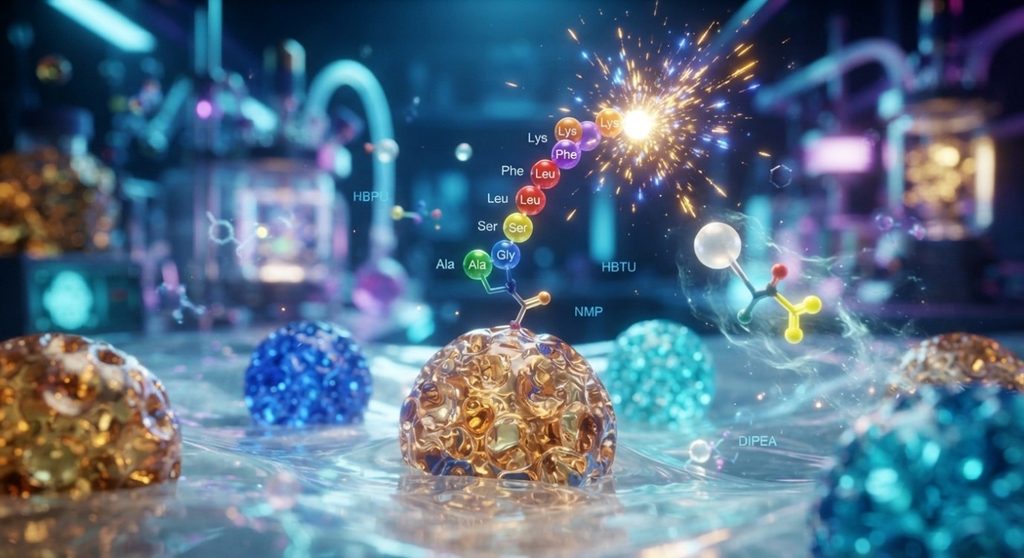
Many peptides currently are synthesized one amino acid at a time by solid phase peptide synthesis (SPPS), but the world’s largest volume peptides are assembled from shorter peptide chains. Tirzepatide is assembled from four fragments synthesized by SPPS.[1] Semaglutide adds a synthetic element to a segment produced by recombinant means.[2]
Peptide assembly from fragments is hardly new: Emil Fischer[3] and Theodor Curtius[4] described their synthetic approaches to proteins 120 years ago. Indeed, coupling through the Curtius Rearrangement is used to this day. Assembly from fragments made by liquid phase peptide synthesis (LPPS) was the only practical way to make peptides of a significant length until Bruce Merrifield’s invention of SPPS allowed researchers to produce much longer peptide chains by sequential addition.[5] New reagents, protecting groups, improved supports and better protocols have made SPPS for peptide synthesis routine.
Fidelity
The great advantage of SPPS over recombinant technology, which was developed in roughly the same period as SPPS, is that non-canonical amino acids and other forms can be incorporated in the sequence. One of the chief disadvantages is the poor process mass intensity (PMI) related to the volume of wash solvents needed to remove reagents and excess amino acids. There is a trade-off between sequence fidelity and PMI (and expense). To avoid “deletion” impurities due to imperfect coupling at a step, two to three equivalents of amino acid and reagents are needed. If one tries to economize by accepting more coupling errors, the cost of purification downstream increases. Indeed, some impurities may not be separable in an economically practical way if allowed to accumulate.
In routine Fmoc SPPS, each amino acid coupling proceeds at roughly 98–99.5% efficiency or a per-step incomplete-coupling rate of about 0.5–2%.[6] Difficult steps (e.g., β-branched Val/Ile/Thr and aggregation-prone regions) can fail far more often, up to ~40% incomplete coupling for unoptimized difficult sequences. Optimized protocols, for example, double coupling of sterically hindered residues and in-process controls, on the other hand, can enhance fidelity to ≥99.5–99.9% per step (error ≤0.1–0.5%).[7] Capping chains that are still not coupled with acetic anhydride prevents further loss and makes the chains that have lost fidelity easier to purge.

A common approach to in-process control is to test the reaction mix post-coupling for the presence of residual free amine. Quantitative ninhydrin, or chloranil/TNBS if coupling proline, can reliably detect free amines down to 0.1%. A policy to recouple if free amine exceeds a defined limit, followed by capping if significant levels of free amine persist can drive the coupling error rate down to 0.1%. Achieving this fidelity comes at a price in process time, reagent and raw material consumption.
| % Correct Sequence (Fidelity) | ||||||
| Error Rate per Step | ||||||
| Length | 0.1% | 0.25% | 0.5% | 1% | 2% | 3% |
| 5 | 99.6% | 99.0% | 98.0% | 96.1% | 92.2% | 88.5% |
| 10 | 99.1% | 97.8% | 95.6% | 91.4% | 83.4% | 76.0% |
| 15 | 98.6% | 96.6% | 93.2% | 86.9% | 75.4% | 65.3% |
| 20 | 98.1% | 95.4% | 90.9% | 82.6% | 68.1% | 56.1% |
| 25 | 97.6% | 94.2% | 88.7% | 78.6% | 61.6% | 48.1% |
| 30 | 97.1% | 93.0% | 86.5% | 74.7% | 55.7% | 41.3% |
| 39 | 96.3% | 90.9% | 82.7% | 68.3% | 46.4% | 31.4% |
If an entire peptide up to a 39-mer is to be synthesized, an average error rate of no more than 0.25% per step is necessary to provide 90% fidelity. Even at an average 0.5% error, only ~83% of the product will have the correct sequence.
Many peptide products with annual volumes less than 50 kg are well served by an SPPS synthesis at a low step error rate. Tirzepatide and semaglutide require annual volumes of metric tons. The limitations of the tradeoffs inherent to linear SPPS synthesis and downstream processing cannot support such high volumes and the assembly of fragments of the peptide product has been found to be the way forward.
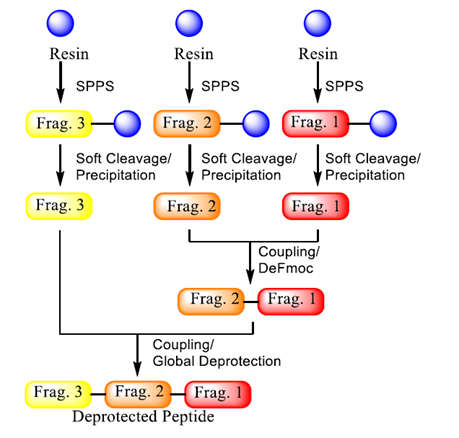
Figure 1: Fragment Synthesis Scheme[8]
Consider a focused version of the table above with peptides up to 15 residues:
| % Correct Sequence | ||||||
| Error Rate per Step | ||||||
| Length | 0.10% | 0.25% | 0.50% | 1% | 2% | 3% |
| 5 | 99.6% | 99.0% | 98.0% | 96.1% | 92.2% | 88.5% |
| 6 | 99.5% | 98.8% | 97.5% | 95.1% | 90.4% | 85.9% |
| 7 | 99.4% | 98.5% | 97.0% | 94.1% | 88.6% | 83.3% |
| 8 | 99.3% | 98.3% | 96.6% | 93.2% | 86.8% | 80.8% |
| 9 | 99.2% | 98.0% | 96.1% | 92.3% | 85.1% | 78.4% |
| 10 | 99.1% | 97.8% | 95.6% | 91.4% | 83.4% | 76.0% |
| 11 | 99.0% | 97.5% | 95.1% | 90.4% | 81.7% | 73.7% |
| 12 | 98.9% | 97.3% | 94.6% | 89.5% | 80.1% | 71.5% |
| 13 | 98.8% | 97.0% | 94.2% | 88.6% | 78.5% | 69.4% |
| 14 | 98.7% | 96.8% | 93.7% | 87.8% | 76.9% | 67.3% |
| 15 | 98.6% | 96.6% | 93.2% | 86.9% | 75.4% | 65.3% |
A fragment of 10 residues will have fidelity > 90% even at a coupling error rate of 1%. This error rate is considerably less expensive to achieve. One needs to choose the fragments carefully, both for efficiency of condensation and to take advantage of the potential for purification of the fragments through crystallization.[9]
SPPS vs TAPS
A related technology to SPPS is tag-assisted peptide synthesis (TAPS). Like SPPS, the peptide chain is immobilized, but instead of an insoluble bead, it is anchored to a solvent soluble large molecule by a covalent bond that can be cleaved using the same chemistries as used in SPPS. The growing peptide chain is coupled in an immiscible solvent layer, for example methyl tetrahydrofuran, and the excess reagents are washed away with water. The reactions are no longer limited by diffusion into a bead and tend to be faster. Reagent requirements are also reduced, often at only 1.05 equivalents.[10] In-process control is easier since the reaction mix is a solution, not a slurry. The manufacturer does not need specialized SPPS equipment. However, as the chain length reaches about 10 residues, the physical characteristics of the anchored peptide can be problematic. Longer chains are less soluble, stabilize emulsions, and water extractions become more difficult.[11] Fortuitously, this is about the peptide length one wants for a fragment.
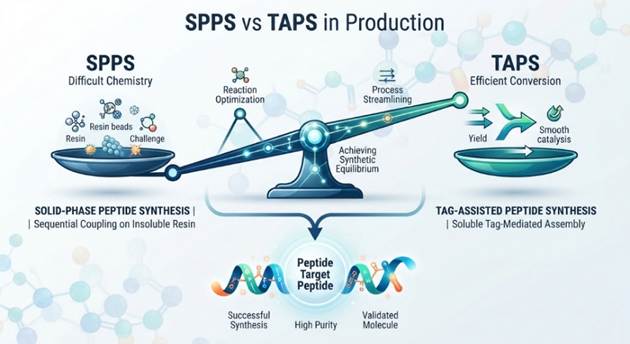
Figure 2: SPPS vs TAPS Decision Drivers
Synthesis of some fragments will prove to be more facile by TAPS and others by SPPS. From an economic standpoint, the reduced materials and waste costs of TAPS can have a significant advantage. SPPS is more flexible with respect to the coupling chemistries that can be used. The efficiency of conversion of costly constituents and the capability to perform unusual coupling chemistries will inform the decision between the synthesis modes.
Because the SPPS or TAPS fragments are the products of a “soft cleavage” from the support or tag, or even still supported when coupled, their protecting groups are still in place and the chemistries to condense fragments together are usually very similar to the chemistries used in their synthesis.
Ligation of Recombinant Fragments
If the peptide has a long sequence of natural amino acids, let’s say 20 residues or more, producing a segment by recombinant means could be a practical approach. Excellent fidelity of expression is a hallmark of recombinant production, which provides high-quality drug substances at metric ton scale. Because the recombinant protein is in water solution, generally the synthetic segments also need to be deprotected to allow ligation in aqueous phase.
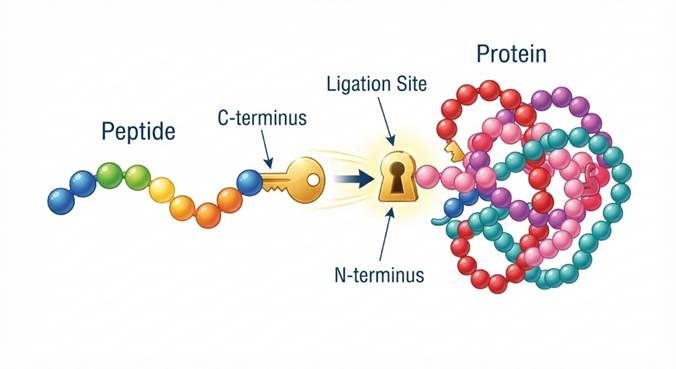
Figure 3: Peptide Ligation Overview
Ligation can be performed chemically. Generally, chemical ligation takes advantage of the properties of particular amino acids in a sequence to ligate peptide segments. By the same token, the presence of particular amino acids can restrict the application of a certain method.
N-hydroxysuccinimide (NHS) chemistry, widely used in ADC conjugation, can be practical when the segment that will become the N-terminus of the ligation product does not have free carboxylic acids other than the C-terminus of the ligation point. Because the segments can have no free amines, other than the N-terminus of the ligation site, one must protect the amines in aqueous solution. This can be done with maleic anhydride.[12] (For more sensitive peptides, dimethylmaleic anhydride or citraconic anhydride are alternatives that allow milder deprotection conditions.) The C-terminus segment is provided with an N-terminus protecting group, often a “leader” with a well-known cleavage enzyme, providing an N-terminus open for ligation. The maleylamide protecting groups are hydrolyzed at low pH to afford the coupled peptide.
Natural Chemical Ligation (NCL), based on cysteine, is well-known. A thioester is formed by thiolysis of a C-terminus hydrazide peptide segment providing the ligation point. Expressed protein ligation (EPL), makes it possible to apply NCL to a recombinant segment. The engineered recombinant sequence places a cysteine at the desired join in a longer sequence. The expressed protein is cleaved to remove the unneeded part of the protein (the N-intein) through thiolysis and converts the cysteine to a thioester at the desired C-terminus position for NCL coupling. Besides NCL, there are similar methods that take advantage of coupling chemistries involving glycine, alanine, serine, homoserine, or threonine.[13]
Keto-hydroxylamine (KAHA) ligation is one option that can be attractive. The C-terminus is activated by a hydroxylamine, which becomes an amino acid in the sequence at the ligation position. Oxazetidine leads to serine and a 4-membered ring hydroxylamine leads to threonine. By use of Fmoc or Boc protected hydroxylamines, segments have been sequentially ligated to form large peptides of about 150 amino acids.[14]
Enzymatic ligation has historically been even more restrictive than chemical ligation with respect to the applicable sequences. However, peptiligase (sometimes called omniligase-1) is relatively flexible with only two limitations on the acyl donor peptide (or “ester”): the P4 position requires hydrophobic or weakly polar amino acids, while in the P1 position, proline is not accepted. Conversely, proline is not tolerated both in the P1’ and P2’ positions of the acyl acceptor (or “amine”). The only other requirement is that the C-terminal fragment must bear an activated ester, typically the carboxyamidomethyl (OCam) ester.[15]
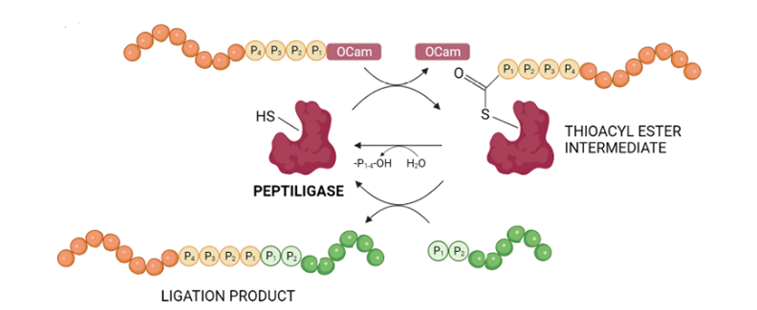
Figure 4: Enzymatic Ligation with Peptilagase [16]
The acyl donor together with the Ocam ester can be formed by SPPS or TAPS and the amine can be the recombinant segment, though the technique is not limited to segments from a particular source. For best results, the ligase should be the subject of an optimization program to find the best ligation points in the sequence and to apply molecular biology methods to make a ligase with the best properties for the specific peptide.
[1] Frederick, M.O., et al., Org. Process Res. Dev. 2021, 25, 1628−1636
[2] Ozempic Assessment Report, EMA/CHMP/715701/2017
[3] Fischer, E. Synthese von Polypeptiden. XVII. Berichte der Deutschen Chemischen Gesellschaft 1907, 40 (2), 1754–1767
[4] Curtius, T. Synthetische Versuche mit Hippurazid. Berichte der Deutschen Chemischen Gesellschaft 1902, 35 (3), 3226–3228
[5] Mitchell, A. R., “R. Bruce Merrifield and Solid-Phase Peptide Synthesis: A Historical Assessment”, UCRL-JRNL-237037, 5 Dec 2007
[6] Peptide Journal, “Why Are Peptides So Expensive?” — https://www.peptidejournal.org/faq/why-are-peptides-so-expensive
[7] Peptide Recon, Peptide Manufacturing Standards — https://peptiderecon.com/guides/quality/manufacturing-standards.html
[8] Frederick, M.O., et al., Org. Process Res. Dev. 2021, 25, pg 1630.
[9] Kim, Y., et al., Org. Process Res. Dev. 2026, 30, 1259−1267
[10] PMC11002941, Process Mass Intensity Analysis (near-stoichiometric TAPS; propylamine quench; >93% crude)
[11] https://cordenpharma.com/what-you-need/apis/tag-assisted-peptide-synthesis-taps/
[12] Biochem J. 1969 May;112(5):679-89
[13] Chem. Rev. 2019, 119, 7328−7443
[14] Agnew. Chem. Int. Ed., 2019, 58, 12599-12603
[15] Green Chem., 2019, 21, 6451
[16] Rossino, G., et al., Molecules 2023, 28, 7165, pg 30.

