
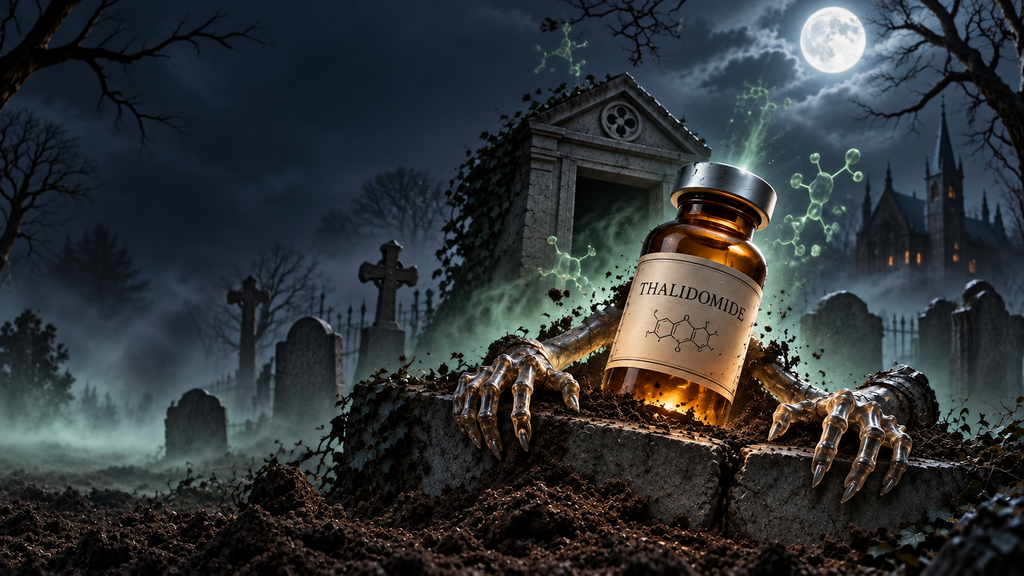
A drug candidate can fail without being useless. It may miss its original target, produce an unexpected effect, or prove too risky for one patient population but valuable for another. Sometimes it is shelved because the evidence is insufficient, the economics no longer make sense, or a company’s priorities change. Development may stop, but the compound remains.
The pharmaceutical “graveyard” is less like a cemetery than an archive: a collection of molecules whose potential was never fully resolved, and which may be summoned should the need arise. Sometimes a new target, a better understanding of biology, or a different way to deliver the drug can justify reopening the file.
Thalidomide is one of the most striking and morally complex examples. Its history is not a simple story of a failed drug finding a second chance. It is a story of a medicine withdrawn for causing devastating harm, then later reconsidered for conditions in which its effects could be useful under strict controls.
In 1964, physician Jacob Sheskin observed an unexpected improvement in a patient with erythema nodosum leprosum, a painful inflammatory complication of leprosy. Subsequent research supported thalidomide’s use for this condition, and the U.S. Food and Drug Administration approved it for erythema nodosum leprosum in 1998. Research later explored its activity in multiple myeloma; the FDA approved thalidomide in combination with dexamethasone for newly diagnosed multiple myeloma in 2006.
The underlying biology helps explain why the compound performs in seemingly unrelated diseases. Thalidomide affects immune and inflammatory processes, and researchers investigated how those effects might apply beyond its initial uses. But a plausible mechanism is a lead, not proof. A drug that looks promising in a laboratory—or in one group of patients—still needs evidence that it provides meaningful benefit for a new condition.
Thalidomide’s return also came with an essential qualification: its potential benefits do not erase its history. Exposure during pregnancy can cause severe birth defects. Its use therefore requires stringent safeguards to prevent fetal exposure. In this case, the question was never simply whether the drug could work again. It was whether a benefit for specific patients could be pursued while managing an exceptionally serious risk.
For pharmaceutical leaders, this is the lesson: repurposing is not a shortcut around development. A new indication needs its own evidence, patient population, dosing rationale, benefit-risk assessment, and regulatory strategy. The fact that a compound has already been studied may reduce some uncertainty, but it does not settle the central question: does it help the people now being considered for treatment, and are the risks acceptable for them?
That assessment starts with a disciplined review of why the original program stopped. Was the target biology wrong? Did the trial design fail to measure the effect? Was the safety issue dose-dependent, or specific to a particular population? Did the commercial case disappear before the science was fully tested? Each answer points toward a different path, and some lead to a clear message: “do not restart.”
The next step is to look for a credible new rationale. Modern tools can help researchers compare a compound’s known biological activity with disease pathways, identify potential patient subgroups, or revisit older datasets. These methods can generate hypotheses and prioritize experiments. They cannot, on their own, establish that a medicine is safe or effective for a new use.
An informed portfolio strategy treats shelved compounds as options, not hidden assets waiting to be monetized. That means preserving useful data, documenting why programs ended, and setting clear thresholds for reinvestment. It also means resisting the temptation to overinvest in a resurrection narrative before rigorous testing supports it.
Thalidomide shows both sides of the proposition. A drug can find a role beyond its original one, and that role can be clinically important. But rediscovery is not redemption: the evidence must stand on its own, and the patient’s risk must remain central. The graveyard contains overlooked possibilities alongside compounds that were shelved for good reason. The work lies in knowing which is which.

